River
Detailed and continuous. Try it for reading, writing or work that benefits from a bright sense of motion.

River, rain and ocean sounds each shape the room differently. Try all three at a low volume, notice which one asks the least of your attention, then use it for one complete study block.
Free download · No account · No ads · Background playback
Detailed and continuous. Try it for reading, writing or work that benefits from a bright sense of motion.
Soft and steady. Try it when nearby voices or irregular sounds make the room feel too exposed.
Broader and more periodic. Try it for a longer task when you want space without lyrics or guidance.
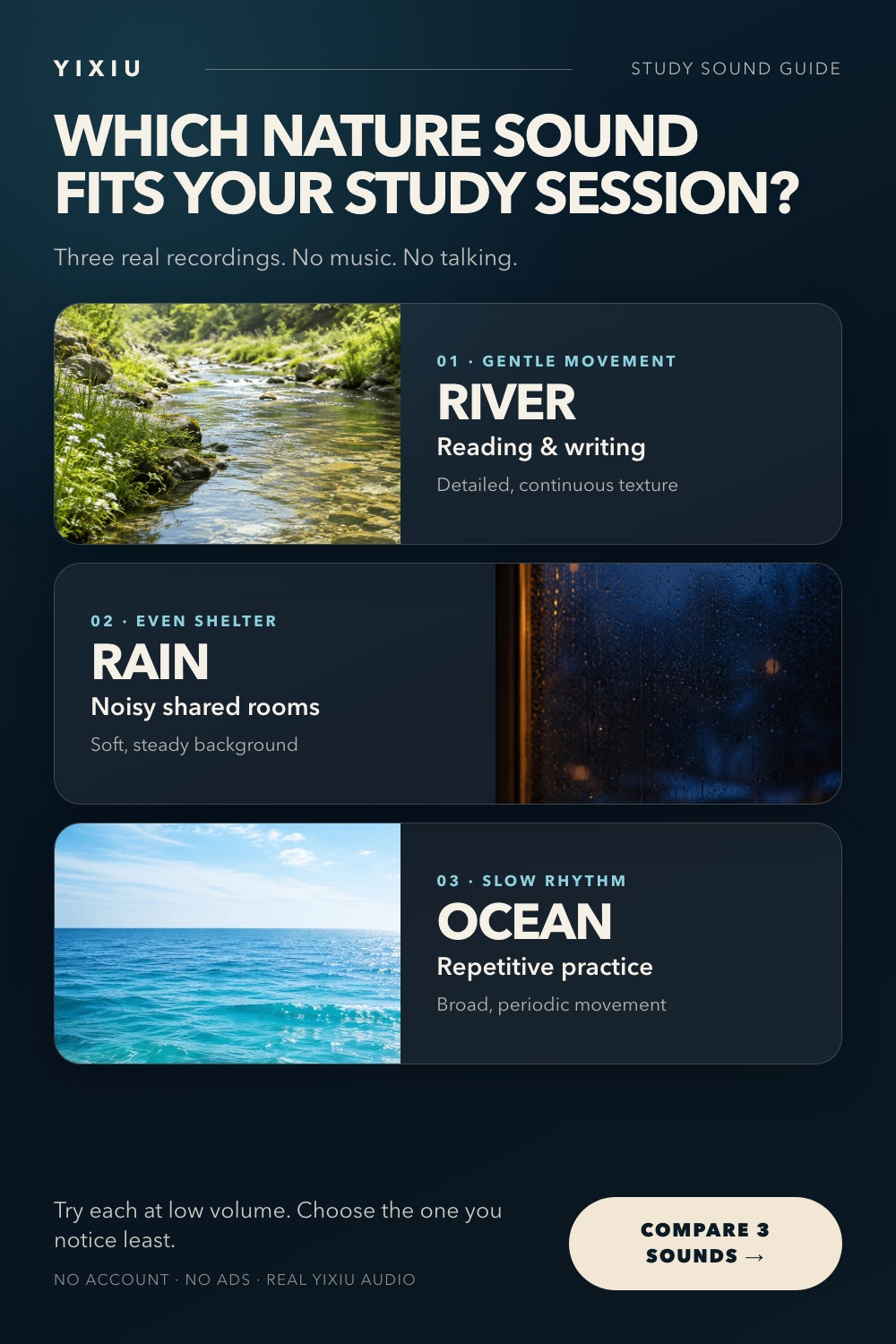
River has more detail, rain is more even, and ocean moves in a broader rhythm. Use this map to choose a starting point, then let your ears make the final decision with the three real previews above.
Compare the three recordings ↑A study background should soften the room without becoming the thing you monitor. If a sound makes you wait for the next wave or splash, lower it or choose another.
Begin with river or rain because neither contains lyrics. Keep it quiet enough that the words on the page remain more vivid than the sound.
Ocean waves can add a slow external rhythm to drills, review or routine tasks without introducing a melody.
Rain is the most even of the three. Use it at the lowest level that reduces the contrast of nearby conversation.
Do not browse sound libraries for twenty minutes. Use the same paragraph or problem for each short test, then commit to one sound.
Use the actual chapter, draft or worksheet—not a blank screen—so the comparison matches the work you need to do.
Keep the device volume fixed while you move from river to rain to ocean. Notice which one fades from awareness fastest.
Set a 15- or 30-minute timer and stop adjusting. The point is to return to the work, not perfect the atmosphere.
There is no single best sound for everyone. Start with the lowest-volume option that softens nearby distractions without pulling your attention away from the work.
River sounds have more movement and detail, while rain is usually more even. Try both below the level of your reading voice and keep whichever feels less noticeable.
Ocean waves avoid lyrics and melody, which may suit language-heavy work. If familiar instrumental music already works for you, there is no need to change it.
Begin with a short block you can finish, such as 15 or 30 minutes. Choose one visible task before the timer starts and keep the sound unchanged until it ends.